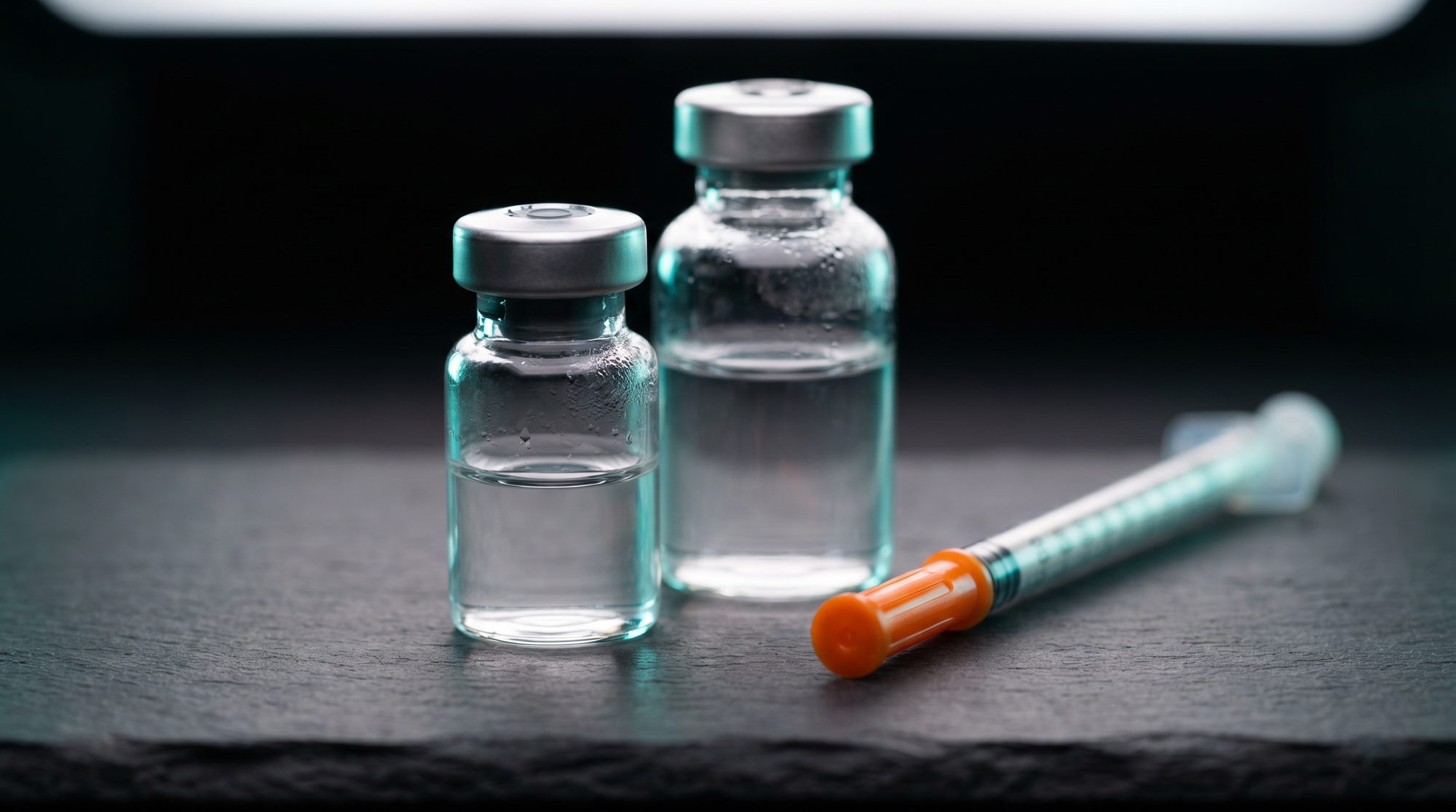
HCG on TRT is typically dosed at 250–500 IU subcutaneously, two to three times per week, alongside testosterone to keep the testes signaling and producing intratesticular testosterone. It preserves fertility, prevents testicular atrophy, and — for many men — maintains the feeling that their body still works the way it used to.
The decision to add HCG isn't automatic. It depends on your age, your fertility plans, how your body responds to testosterone alone, and what your prescriber thinks makes sense for your protocol. This guide walks through every piece of that decision — with specific numbers, real mechanisms, and the practical details most clinic pages skip.
What Is HCG and Why Do Men on TRT Use It?
Human chorionic gonadotropin (HCG) is a hormone that mimics luteinizing hormone (LH). When you start TRT, your brain stops sending LH to your testes — so they stop making testosterone, shrink, and halt sperm production. HCG replaces that missing LH signal, keeping the testes active while you're on exogenous testosterone.
Your hypothalamic-pituitary-gonadal (HPG) axis is essentially a thermostat. Exogenous testosterone trips the thermostat, the pituitary stops releasing LH and FSH, and your testes — with nothing telling them to work — go quiet. HCG bypasses the shut-off by hitting the same LH receptors directly on Leydig cells.
According to a PubMed review on HCG for hypogonadal men and the StatPearls monograph on human chorionic gonadotropin, HCG binds to the same receptors as LH and stimulates both testosterone production and spermatogenesis within the testes themselves. That's why it's used alongside TRT rather than as a replacement for it — it keeps the local testicular environment functional while systemic testosterone comes from your weekly shot.
Do You Actually Need HCG on TRT?
You need HCG on TRT if you want to preserve fertility, want to avoid testicular atrophy, or feel noticeably worse without the testicular hormonal contribution. You don't strictly need it if you're past family planning, don't care about testicular size, and feel fully dialed in on testosterone alone. It's a protocol decision, not a safety requirement.
Here's a rough decision framework that reflects how most TRT-experienced clinicians think about it:
| Situation | HCG recommendation |
|---|---|
| Under 40, may want kids | Strongly consider HCG from day one |
| 40–50, unsure about future kids | Consider HCG as insurance |
| Over 50, done having kids | Optional — based on symptoms and preference |
| Testicular atrophy already bothering you | Add HCG; may partially reverse |
| Feel flat/numb on testosterone alone | Trial HCG — many men report mood/libido improvement |
| Already dialed in, no complaints | No compelling reason to add |
The cost of HCG is real — it's a second injectable, a second prescription, and usually $40–120/month depending on your pharmacy. If you don't need it, you don't need it. If you do, it's worth every dollar.
Did You Know? Testicular volume can drop by 20–40% within a few months of starting testosterone alone. Men who add HCG from the start rarely see this shrinkage — it's preventive, not reactive.
How Often Should You Take HCG on TRT?
Most TRT protocols dose HCG two to three times per week. A typical schedule is 250 IU on Monday, Wednesday, and Friday, or 500 IU twice per week aligned with testosterone injection days. HCG has a biological half-life of roughly 33 hours, so dosing every two to three days keeps Leydig cells consistently stimulated without unnecessary spikes.
Daily dosing isn't needed and isn't how most prescribers write it. Once-weekly dosing tends to leave gaps where LH-equivalent signal drops off. The sweet spot — what most men run long-term — is every two to three days.
Common schedules you'll see in the wild:
- 250 IU three times per week (Mon/Wed/Fri) — the most common maintenance pattern
- 500 IU twice per week (same days as your testosterone injection) — simpler, fewer injections, slightly higher peaks
- 100 IU daily or every other day — less common, sometimes used for sensitive responders who want very steady levels
If you're already injecting testosterone subcutaneously, adding HCG is a rhythm shift, not a whole new routine. Our TRT dosage chart walks through how to align ancillary injections with your main protocol.
What's the Minimum HCG Dose That Works with TRT?
The minimum effective HCG dose with TRT is around 500 IU per week (split into 2–3 doses). A landmark Fertility and Sterility study (Coviello et al., 2005) found that just 500 IU every other day preserved intratesticular testosterone at pre-TRT levels — meaning fertility and testicular function were maintained with strikingly low dosing.
That study is the reference most clinicians cite when picking a dose floor. Men who took 125 IU every other day still preserved intratesticular testosterone, but less reliably. Men who took 500 IU every other day hit pre-TRT intratesticular levels across the board.
Translating that research into real protocols:
| Goal | Weekly HCG total | Typical split |
|---|---|---|
| Minimum to preserve fertility | 500–750 IU | 250 IU 2–3x/week |
| Standard maintenance | 750–1,000 IU | 250–333 IU 3x/week |
| Active fertility attempt | 1,500–3,000 IU | 500–1,000 IU 3x/week |
| Restart/PCT after stopping TRT | 2,000+ IU | Clinician-directed tapered dose |
The takeaway: you don't need heroic doses. The difference between 500 IU/week and 1,500 IU/week is often marginal for maintenance purposes. Use the lowest dose that keeps your symptoms, testicular volume, and bloodwork where you want them.
HCG Dosage Guide for Men on TRT
A practical HCG dosage guide for men on TRT looks like this: start at 250 IU two to three times per week, reassess after 6–8 weeks based on how you feel and how your testicles look and function, and adjust upward only if symptoms warrant it. Most men settle at 250–500 IU 2–3x/week long-term.
Here's a full breakdown of what men typically run, by goal:
Maintenance (most men on TRT who add HCG): - 250 IU subcutaneous, 3x per week - Injection sites: abdomen or upper thigh - Needle: 29–31G, 1/2" insulin syringe - Storage: refrigerate after mixing; use within ~30 days
Pre-conception (trying to conceive within 3–12 months): - 500 IU subcutaneous, 3x per week (1,500 IU/week) - Often paired with FSH or hMG if sperm count doesn't recover - Requires 3–6 months of consistent dosing for sperm parameters to normalize
Testicular recovery (reversing existing atrophy): - 500 IU subcutaneous, 3x per week for 8–12 weeks - Then taper to 250 IU 3x/week maintenance - Visible volume recovery usually within 4–8 weeks
Our guide to needle gauge for testosterone injections covers the basics of picking the right syringe — HCG uses the same small-gauge insulin syringes you'd use for subcutaneous testosterone.
HCG and Fertility on TRT: What the Research Actually Shows
Research consistently shows that adding HCG to TRT preserves sperm production in most men, while TRT alone suppresses sperm counts in roughly 65% of users within 6 months. The Journal of Urology published data showing that men on testosterone plus HCG maintained near-normal sperm parameters, compared to dramatic suppression on testosterone alone.
The mechanism is straightforward: sperm production (spermatogenesis) requires extremely high intratesticular testosterone — roughly 50–100 times higher than blood serum levels. Systemic TRT cannot achieve these intratesticular concentrations because exogenous testosterone suppresses the LH signal that drives local production. HCG restores that signal.
A few specific numbers worth knowing:
- TRT alone reduces sperm count to oligospermic or azoospermic levels in approximately 65% of men within 6 months
- Adding HCG (500 IU every other day) maintains sperm counts in ~95% of men
- If sperm production is lost on TRT-only, most men recover within 4–12 months of stopping T and starting HCG-based restart protocols — but roughly 10–15% take longer or don't fully recover
If fertility matters to you even as a distant possibility, adding HCG from day one is cheap insurance. If it doesn't, there's no penalty to running testosterone alone. Our article on what happens when you stop TRT covers the restart side in more depth.
What Happens If You Take TRT Without HCG?
Without HCG on TRT, your pituitary stops sending LH and FSH, so your testes shut down. Expect a 20–40% reduction in testicular volume within 3–6 months, near-complete cessation of endogenous testosterone and sperm production, and — for a meaningful percentage of men — a subtle but noticeable change in how TRT "feels" compared to HCG-inclusive protocols.
Here's the typical timeline of testicular changes on TRT without HCG:
| Weeks on TRT (no HCG) | What's happening |
|---|---|
| 2–4 | LH/FSH drop to near-zero; intratesticular T collapses |
| 6–12 | Noticeable softening; mild volume reduction begins |
| 12–26 | Visible shrinkage (20–40% smaller); sperm counts bottom out |
| 26+ | Stable atrophy; if reversed, takes 3–12 months of restart protocol |
Atrophy isn't medically dangerous — it's cosmetic and hormonal. But it's irritating enough that many men who initially skip HCG come back and add it later. Running HCG from the beginning is easier than reversing atrophy months in.
For a fuller view of TRT's broader risk profile, our guide to the side effects of TRT covers the effects that go beyond testicular changes.
How to Reconstitute and Inject HCG
HCG ships as a lyophilized (freeze-dried) powder in a glass vial. To use it, you mix it with bacteriostatic water that your pharmacy provides separately. Once reconstituted, it becomes a clear, colorless liquid that you inject subcutaneously — usually into the abdomen or thigh with a small insulin syringe.
The reconstitution steps most prescribing clinicians walk you through:
- Gather supplies. HCG vial, bacteriostatic water vial, 3 mL mixing syringe with 22–25G drawing needle, insulin syringes (29–31G, 1/2"), alcohol swabs.
- Draw the water. Wipe the bac water vial top with alcohol. Draw the volume specified on your prescription (commonly 3 mL or 5 mL depending on dose math).
- Inject water slowly. Angle the needle against the inside wall of the HCG vial — you don't want to spray directly onto the powder. Let the water run down the glass.
- Swirl gently. Do not shake. HCG is a protein and shaking can denature it. Swirl until the powder fully dissolves (usually within 30 seconds).
- Refrigerate. Store the reconstituted vial in the fridge. Stable for roughly 30 days once mixed.
- Draw your dose. Using an insulin syringe, pull the volume corresponding to your prescribed IU (the math depends on your dilution — your pharmacy or prescriber should provide the specific conversion).
- Inject subcutaneously. Pinch abdominal fat or outer thigh, insert at 45–90°, inject slowly, withdraw. No aspiration needed for subq.
Dose math worth knowing: if you reconstitute a 10,000 IU vial with 10 mL of bac water, each 0.1 mL (10 units on an insulin syringe) equals 100 IU. A 250 IU dose is 0.25 mL, or 25 units on the syringe.
Our subcutaneous vs intramuscular injection guide covers technique basics that apply directly to HCG.
HCG Benefits Beyond Fertility
Beyond fertility, men on TRT commonly report that HCG improves mood, libido, ejaculate volume, and a general sense of feeling "more normal" compared to testosterone alone. Some of these effects are mechanistically plausible (intratesticular hormones contribute to overall endocrine balance), others are subjective — but both matter when you're living the protocol.
The most consistently reported benefits from men who've run TRT both with and without HCG:
- Libido recovery. Men whose libido felt flat on testosterone alone often report it returning after adding HCG. The mechanism isn't fully mapped, but intratesticular steroids and neurosteroid pathways likely play a role.
- Ejaculate volume. TRT alone can reduce ejaculate volume significantly. HCG restores much of it because the seminal vesicles and prostate rely on local hormonal signaling.
- Mood stability. Anecdotally, many men describe a "flatness" or emotional dulling on T-only that partially resolves on HCG. Harder to measure, real for the men who feel it.
- Testicular fullness. Preserving testicular volume matters to many men independent of fertility — it's a body-image and self-perception factor that deserves to be named.
- Protocol confidence. Men who know their HPG axis is still "on" tend to feel more comfortable with long-term TRT.
The Endocrine Society's testosterone therapy guidelines acknowledge HCG as appropriate for men on TRT who want to preserve fertility — and many TRT-specialized clinicians interpret that same guideline as justification for HCG's broader quality-of-life benefits.
HCG vs Enclomiphene vs Nothing: Which Is Right for You?
Choosing between HCG, enclomiphene, or neither comes down to how you prefer to preserve testicular function: HCG works locally at the testes, enclomiphene works upstream at the pituitary, and "nothing" is fine if you're past fertility concerns and tolerate atrophy well. Each has real trade-offs.
| Option | How it works | Best for | Downsides |
|---|---|---|---|
| HCG | Mimics LH directly at testes | Fertility preservation + atrophy prevention | Another injection; $40–120/month; refrigeration |
| Enclomiphene | Blocks estrogen at pituitary → ↑ LH/FSH | Men who want endogenous production without injections | Less effective once TRT-suppressed; may not pair well with TRT |
| Nothing | N/A | Men past family planning who feel fine on T-only | Testicular atrophy; infertility; possible mood/libido flatness |
A key nuance: enclomiphene works best instead of TRT, not alongside it. Once you're fully suppressed on testosterone, enclomiphene has little pituitary signal to unlock. That's why most practical TRT protocols that include an ancillary pick HCG.
If you're still deciding whether to start testosterone at all, our guide on how to get on TRT covers the prescribing conversation — including how to raise HCG as part of your initial protocol discussion.
Side Effects of HCG on TRT
HCG is generally well-tolerated at TRT-adjunct doses, but it can cause a few predictable side effects: elevated estradiol (because Leydig cell activation increases aromatization at the source), occasional acne flares, injection-site irritation, and — rarely — gynecomastia if estradiol spikes aren't managed. Most of these are dose-dependent and reversible.
The most common issues to watch for:
- Elevated estradiol (E2). HCG stimulates testicular testosterone, some of which aromatizes to estradiol locally. Men already prone to high E2 on TRT may see this amplified. Bloodwork 6–8 weeks after adding HCG catches it.
- Acne. Increased androgen activity at the skin level can flare acne, especially on the back and shoulders. Usually dose-responsive.
- Injection site reactions. Small lumps, redness, or mild irritation at subq injection sites. Rotating sites helps.
- Water retention / puffiness. Usually tied to estradiol rather than HCG itself.
- Testicular ache. Some men report mild testicular tenderness for the first week or two — typically resolves as Leydig cells adjust.
- Gynecomastia risk. Rare at maintenance doses; more of a concern at higher "fertility-attempt" doses without E2 monitoring.
Desensitization at very high long-term doses is a theoretical concern, but at maintenance dosing (250–500 IU 2–3x/week), it's not a clinical issue most men encounter. Per the PubMed review on HCG, sustained low-dose HCG maintains Leydig cell responsiveness over extended periods.
How to Track HCG Alongside Your TRT Protocol
HCG is a second injectable on a separate schedule — which means tracking gets more complicated than a single weekly testosterone shot. You're now logging multiple compounds, different doses, different injection sites, and watching how combined bloodwork responds over time. A dedicated tracker makes this trivial instead of messy.
The variables worth logging when you run HCG + TRT:
- Date, time, and site of every HCG injection (3x/week adds up fast)
- Dose in IU (and your reconstitution ratio — it matters if it drifts)
- Days since last dose (to catch when you accidentally skip)
- Subjective symptoms (libido, mood, testicular fullness) on a simple 1–5 scale
- Bloodwork (total T, free T, estradiol, LH, FSH) at standard intervals
Most men running ancillaries on paper or in a notes app end up with gaps — a skipped Wednesday dose nobody noticed, a site-rotation pattern that's really just "left thigh always," or bloodwork drawn at the wrong point in the cycle. These gaps muddy the signal when you're trying to answer "is this working?"
How Himcules Helps You Track HCG With Your TRT Protocol
Himcules was built for exactly this kind of protocol — multiple injectables, multiple schedules, and the small daily details that decide whether your labs tell a clean story six months from now. You can log HCG as a separate compound alongside testosterone, tag each injection with dose and site, and see your adherence trend on a single timeline.
The app keeps everything on your device by default — no cloud account required, no health data leaking to an insurer — and the symptom tracking takes about 15 seconds per entry. When you get bloodwork back, you can pull up a clean history of what you actually injected and when, instead of reconstructing it from memory.
You can download Himcules free on iOS to log HCG and testosterone side by side without spreadsheets or guesswork. Our testosterone injection tracker guide walks through the setup in detail.
Key Takeaways
Q: How fast does HCG work on TRT? A: Most men notice testicular fullness returning within 2–4 weeks of starting HCG. Libido and ejaculate volume improvements typically follow within 4–8 weeks. Sperm parameter changes take longer — usually 3–6 months.
Q: What is the best HCG dose for men on TRT? A: The most common maintenance dose is 250 IU subcutaneously, 2–3 times per week. This preserves testicular function and fertility for most men without driving estradiol too high. Adjust based on 6–8 week bloodwork.
Q: What happens if I take TRT without HCG? A: Expect a 20–40% reduction in testicular volume within 3–6 months, near-complete suppression of sperm production, and — for some men — a noticeable change in mood, libido, or ejaculate volume. Testicular atrophy is cosmetic and usually reversible, but not always quickly.
Q: How do I tell if HCG is working? A: Testicular size and firmness are the most visible indicator — men typically notice a return to pre-TRT fullness within a few weeks. Beyond that, watch for improvements in libido, ejaculate volume, and general mood. Bloodwork (LH-independent testicular signaling is harder to measure, but estradiol changes can be a proxy).
Q: Do I need HCG with TRT? A: You need it if you want to preserve fertility, prevent testicular atrophy, or feel better than you do on testosterone alone. You don't strictly need it if you're past family planning and feel dialed in on T-only. It's a protocol choice, not a safety requirement.
Q: Is HCG necessary on TRT? A: No — HCG is optional from a pure safety standpoint. But it's often recommended for men under 50, men planning future children, and men who feel the quality-of-life difference. Many experienced TRT clinicians add it by default.
Q: Can you take HCG instead of TRT? A: Yes, HCG-only protocols exist as an alternative to TRT for men with secondary hypogonadism (low T driven by pituitary issues, not testicular failure). HCG directly stimulates the testes, potentially raising testosterone without exogenous T. It's less commonly used than TRT but is a legitimate option for men prioritizing fertility.
Sources
- Crosnoe LE, Grober E, Ohl D, Kim ED. "Exogenous testosterone: a preventable cause of male infertility." Translational Andrology and Urology, 2013. pmc.ncbi.nlm.nih.gov/articles/PMC4708307/
- La Vignera S, Condorelli RA, et al. "Indications for the use of human chorionic gonadotropic hormone for the management of infertility in hypogonadal men." PMC, 2016. pmc.ncbi.nlm.nih.gov/articles/PMC4871191/
- Coviello AD, Matsumoto AM, Bremner WJ, et al. "Low dose human chorionic gonadotropin maintains intratesticular testosterone in normal men with testosterone-induced gonadotropin suppression." Fertility and Sterility, 2005. pubmed.ncbi.nlm.nih.gov/15865933/
- Hsieh TC, Pastuszak AW, Hwang K, Lipshultz LI. "Concomitant intramuscular human chorionic gonadotropin preserves spermatogenesis in men undergoing testosterone replacement therapy." Journal of Urology, 2013. pubmed.ncbi.nlm.nih.gov/23375981/
- Bhasin S, Brito JP, Cunningham GR, et al. "Testosterone Therapy in Men With Hypogonadism: An Endocrine Society Clinical Practice Guideline." Journal of Clinical Endocrinology & Metabolism, 2018. pubmed.ncbi.nlm.nih.gov/29562364/
- Ramasamy R, Kovac JR, Lipshultz LI. "Testosterone replacement therapy and fertility." Asian Journal of Andrology, 2015. pmc.ncbi.nlm.nih.gov/articles/PMC4291881/
- McBride JA, Coward RM. "Recovery of spermatogenesis following testosterone replacement therapy or anabolic-androgenic steroid use." Asian Journal of Andrology, 2016. pmc.ncbi.nlm.nih.gov/articles/PMC4854084/
- Patel AS, Leong JY, Ramasamy R. "Human Chorionic Gonadotropin." StatPearls [Internet], NCBI Bookshelf. ncbi.nlm.nih.gov/books/NBK532950/
This article is for informational purposes only and is not medical advice. HCG is a prescription medication in the United States. Always consult your healthcare provider about your TRT protocol, including whether HCG is appropriate for you and what dosing is right for your situation.